Ocean Temperatures
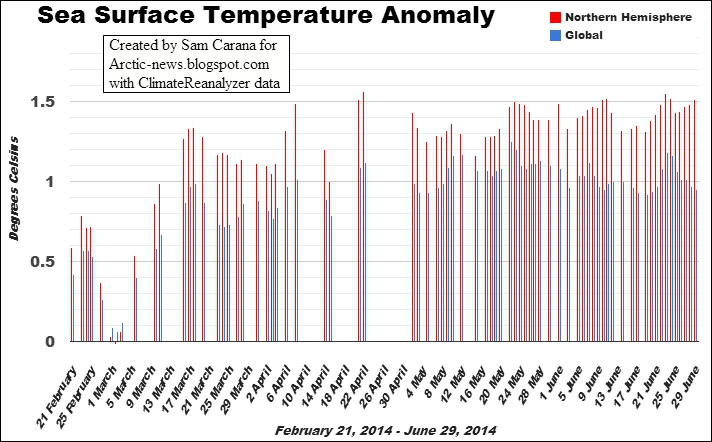
Globally, the average September ocean temperature marked a record high for that month in 2014, at 0.66°C (1.19°F) above the 20th century average, breaking the previous record that was set just one month earlier. On the Northern Hemisphere, the temperature of the ocean in September 2014 was 0.83 °C (or 1.49 °F) above the 20th century,

The anomaly was 0.84 °C in August 2014, as illustrated by the image below.

On specific days, anomalies were much higher. On August 19, 2014, the Northern Hemisphere showed a sea surface temperature anomaly of 1.78 °C, while the North Atlantic sea surface temperature was 1.82 °C above average (CFSR 1979-2000 Baseline) on October 16, 2014, as illustrated by the image below.

Sea surface temperature anomalies are at the top end of the scale in many places in the Arctic, as well as off the coast of North America. The danger is that the Gulf Stream will keep carrying ever warmer water from the North Atlantic into the Arctic Ocean, threatening to unleash huge methane eruptions from the Arctic Ocean's seafloor, in turn causing even higher temperatures and more extreme weather events, wildfires, etc.

Above image shows methane levels as high as 2666 ppb, as measured by the MetOp-2 Satellite at 14,385 ft (~4.4 km) altitude on October 26, 2014 am.
Is 2666 ppb as high as it will get?
Sadly, methane releases from the seafloor of the Arctic Ocean are becoming increasingly larger around this time of year and they look set to get even larger than this. Note that the amount of methane actually erupting from the seafloor of the Arctic Ocean is even larger than what is visible on above image, for the following three reasons.

On specific days, anomalies were much higher. On August 19, 2014, the Northern Hemisphere showed a sea surface temperature anomaly of 1.78 °C, while the North Atlantic sea surface temperature was 1.82 °C above average (CFSR 1979-2000 Baseline) on October 16, 2014, as illustrated by the image below.
Sea surface temperature anomalies are at the top end of the scale in many places in the Arctic, as well as off the coast of North America. The danger is that the Gulf Stream will keep carrying ever warmer water from the North Atlantic into the Arctic Ocean, threatening to unleash huge methane eruptions from the Arctic Ocean's seafloor, in turn causing even higher temperatures and more extreme weather events, wildfires, etc.
Above image shows methane levels as high as 2666 ppb, as measured by the MetOp-2 Satellite at 14,385 ft (~4.4 km) altitude on October 26, 2014 am.
Is 2666 ppb as high as it will get?
Sadly, methane releases from the seafloor of the Arctic Ocean are becoming increasingly larger around this time of year and they look set to get even larger than this. Note that the amount of methane actually erupting from the seafloor of the Arctic Ocean is even larger than what is visible on above image, for the following three reasons.
- No data were available for some areas, as the IASI (Infrared Atmospheric Sounding Interferometer) instrument measuring methane only covers a certain width. The white shapes showing up on above images are areas where no measurements were taken, resulting from the way the polar-orbiting satellite circum-navigates the globe, as pictured on the image on the right.
Furthermore, quality control failed in the grey areas on above images, indicating reading difficulties due to high moisture levels (i.e. snow, rain or water vapor), as also discussed in an earlier post. Accordingly, high methane levels (above 1950 ppb) as show up in the yellow areas could also be present in the many grey areas over the Arctic Ocean.
When also looking at methane levels on days following the high 2666 ppb reading, methane is persistently present over most of the Arctic Ocean, as illustrated by the above October 29, 2014, combination image, confirming that high methane levels were likely present in areas where no data were available on October 6, 2014.
- Much of the methane that is released from the Arctic Ocean's seafloor is broken down by microbes as it rises up in the water. The SWERUS-3 research team recently found methane in the waters of the East Siberian Sea at levels that equate to atmospheric levels of 3188 ppb.
- Much methane is broken down in the atmosphere by hydroxyl, as illustrated by the image below, showing carbon dioxde levels on October 27, 2014, that indicate that large amounts of methane are broken down at higher latitudes on the Northern Hemisphere.


The latter point could explain the sudden recent rise in carbon dioxide levels, as also detected at Mauna Loa, Hawaii, as illustrated by the image below.

In conclusion, the amount of methane that is erupting from the seafloor of the Arctic Ocean is larger than what is visible on satellite images, and the water will be highly saturated with methane at locations where the methane is escaping from the seafloor, highlighting the danger that, in case of large abrupt releases from the Arctic Ocean's seafloor, microbes and hydroxyl will quickly get depleted locally, resulting in little of the methane being broken down, as discussed at an earlier post.
Why are such huge amounts of methane starting to get released from the Arctic Ocean's seafloor now?
As the image below shows, temperature at 2 meters was below 0°C (32°F, i.e. the temperature at which water freezes) over most of the Arctic Ocean on October 26, 2014. The Arctic was over 6°F (3.34°C) warmer than average, and at places was up to 20°C (36°F) warmer than average.

Above image illustrates the enormous amount of heat that has until now been transferred from the waters of the Arctic Ocean to the atmosphere. Underneath the surface, water temperatures are much higher than they used to be and, as around this time of year the Arctic Ocean freezes over, less heat will from now on be able to escape to the atmosphere. Sealed off from the atmosphere by sea ice, greater mixing of heat in the water will occur down to the seafloor of the Arctic Ocean.
As land around the Arctic Ocean freezes over, less fresh water will flow from rivers into the Arctic Ocean. As a result, the salt content of the Arctic Ocean increases, making it easier for ice in cracks and passages in sediments at the seafloor of the Arctic Ocean to melt, allowing methane contained in the sediment to escape. Furthermore, the sea ice makes that less moisture evaporates from the water, which together with the change of seasons results in lower hydroxyl levels at the higher latitudes of the Northern Hemisphere, in turn resulting in less methane being broken down in the atmosphere over the Arctic.
This situation will continue for months to come. Salty and warm water (i.e. warmer than water that is present in the Arctic Ocean) will continue to be carried by the Gulf Stream into the Arctic Ocean, while less heat and moisture will be able to be transferred to the atmosphere.
In conclusion, high methane levels threaten to further accelerate warming in the Arctic, in a vicious cycle escalating into runaway warming and resulting in death, destruction and extinction at massive scale.
So, what can be done to reduce the risk?
Climate Plan
- Emission Cuts
It is imperative that large emissions cuts are made quickly. The Climate Plan calls for 80% emission cuts by 2020, as one of multiple lines of action that need to be implemented in parallel.
- Greenhouse Gas Removal and Storage
The IPCC points at the need for carbon dioxide removal and also warns about ocean warming continuing for centuries (text below).

Indeed, even if all emissions by people could somehow be brought to an abrupt end, this alone will not stop the rise of ocean temperatures, at least not for a long time. For starters, air temperatures would start rising within days, in response to the disappearance of aerosols that now mask the full wrath of global warming. Furthermore, such a temperature rise would further accelerate feedbacks such as snow and ice decline, methane hydrate destabilization, etc., in turn feeding further temperature rises.
The Climate Plan therefore calls for carbon dioxide removal, as well as for active removal of other greenhouse gases from the atmosphere, and for further lines of action.
- Further Action
Again, merely implementing the above lines of action will not suffice to quickly bring down ocean temperatures. Paleo-climate records show that falls in temperature go hand in hand with falls of carbon dioxide in the atmosphere to levels under 280 ppm, as opposed to current carbon dioxide levels that are around 400 ppm.

Raising Funding for Further Action
The Climate Plan calls for comprehensive and effective action that includes additional lines of action. Such additional action will require U.N. supervision, which may make it hard for the necessary action to obtain sufficient funding.
In earlier posts, it was suggested that, besides having fees imposed on facilities that burn fossil fuel and on sales of fossil fuel itself, additional fees could be imposed on commercial international flights. As long as it seems too hard to substantially reduce emissions associated with such flights, it seems appropriate to explore further ways to minimize such flights, e.g. by imposing additional fees that could help fund further action.

Fees could also be calculated on the basis of the traveler's flying history, e.g. in the form of frequent flyer fees. Such fees could be collected either by the respective airline or airport.
In the box on the right, Ekta Kalra gives further details about how the latter idea could be implemented.
What do you think?
References and related posts
- Four Hiroshima bombs a second: how we imagine climate change
http://arctic-news.blogspot.com/2013/08/four-hiroshima-bombs-second-how-we-imagine-climate-change.html
- Arctic Methane Release and Rapid Temperature Rise are interlinked
http://arctic-news.blogspot.com/2013/11/arctic-methane-release-and-rapid-temperature-rise-are-interlinked.html
- Climate Change Accelerating
http://arctic-news.blogspot.com/2014/10/climate-change-accelerating.html
- NOAA, Global Analysis - September 2014
http://www.ncdc.noaa.gov/sotc/global/2014/9
- NOAA Ocean temperature anomalies
http://www.ncdc.noaa.gov/cag/time-series
- Methane Hydrates
http://methane-hydrates.blogspot.com/2013/04/methane-hydrates.html
- Climate Plan
http://climateplan.blogspot.com
Post by Sam Carana.