For anyone attending the September 23, 2014, Climate Summit in New York, it is important to bring the message that, while Congress may seek to deny the physical and legal realities, President Obama can and should act on climate change.
As you know, Sam Carana advocates comprehensive and effective action as discussed at the Climate Plan blog. You can share the message on facebook by clicking on the image below.
A thick layer of smoke blankets large parts of North America, as also illustrated by the animation below based on images from July 15 to 18, 2014, from Wunderground.com.
[ note that this animation is a 2.3MB file that may take some time to fully load ]
Such wildfires can send huge amounts of carbon dioxide, methane, soot, dust and volatile organic compounds into the atmosphere. Much of this gets deposited at higher latitudes, discoloring land, snow and ice, and thus speeding up warming by absorbing more sunlight that was previously reflected back into space.
Soils at higher latitudes can contain huge amounts of carbon in the form of peat, as described in the earlier post The Threat of Wildfires in the North. There are further conditions that make the situation in the Arctic so dangerous.
Temperature anomaly March-April-May-June 2014 (JMA)
The Arctic is particularly vulnerable to warming due to geographics. Seas in the Arctic Ocean are often shallow and covered by sea ice that is disappearing rapidly. Largely surrounded by land that is also rapidly losing its snow and ice cover, the Arctic Ocean acts like a trap capturing heat carried in by the Gulf Stream, which brings in ever warmer water. Of all the heat trapped on Earth by greenhouse gases, 90% goes into oceans, while a large part of the remaining 10% goes into melting the snow and ice cover in the Arctic, as described in an earlier post. Such basic conditions make that the Arctic is prone to warming.
Then, there are huge amounts of methane held in sediments under the Arctic Ocean, in the form of hydrates and free gas. Unlike methane releases from biological sources elsewhere on Earth, methane can be released from the seafloor of the Arctic Ocean in large quantities, in sudden eruptions that are concentrated in one area.
Until now, permafrost and the sea ice have acted as a seal, preventing heat from penetrating these methane hydrates and causing further destabilization. As long as there is ice, additional energy will go into melting the ice, and temperatures will not rise. The ice also acts as a glue, keeping the soil together and preventing hydrate destabilization from pressure changes and shockwaves resulting from seismic activity. Once the ice is gone, sediments become prone to destabilization and heat can more easily move down along fractures in the sediment, reaching hydrates that had until then remained stable.
Temperature anomaly March-April-May 2014 (NASA)
When methane escapes from the seafloor of the Arctic Ocean and travels through waters that are only shallow, there is little opportunity for this methane to be broken down in the water, so a lot of it will enter the atmosphere over the Arctic Ocean. The Coriolis effect will spread the methane sideways, but latitudes over the Arctic are relatively short, making the methane return at the same spot relatively quickly, while the polar jet stream acts as a barrier keeping much of the methane within the Arctic atmosphere. In case of large methane eruptions, the atmosphere over the Arctic will quickly become supersaturated with methane that has a huge initial local warming potential.
Hydroxyl levels in the atmosphere over the Arctic are very low, extending the lifetime of methane and other precursors of stratospheric ozone and water vapor, each of which have a strong short-term local warming potential. In June/July, insolation in the Arctic is higher than anywhere else on Earth, with the potential to quickly warm up shallow waters, making that heat can penetrate deep into sediments under the seafloor.
created by Sam Carana, part of AGU 2011 poster
The initial impact of this methane will be felt most severely in the Arctic itself, given the concentrated and abrupt nature of such releases, with the danger that even relatively small releases of methane from the seafloor of the Arctic can trigger further destabilization of hydrates and further methane releases, escalating into runaway warming.
This danger is depicted in the image on the right, showing how albedo changes and methane releases act as feedbacks that further accelerate warming in the Arctic, eventually spiraling into runaway global warming.
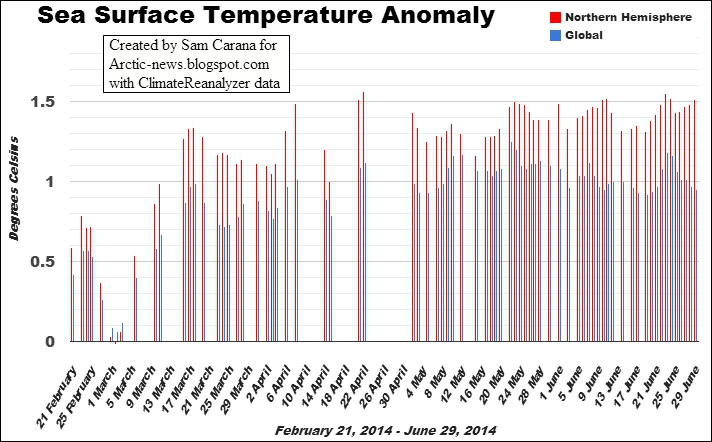
The currently very high sea surface temperature anomalies are illustrated by the two images below.
As the image below right shows, sea surface temperatures as high as 18 degrees Celsius (64.4 degrees Fahrenheit) are currently recorded in the Arctic.
Albedo changes and methane releases are only two out of numerous feedbacks that are accelerating warming in the Arctic.
Also included must be the fact that Earth is in a state of energy imbalance. Earth is receiving more heat from sunlight than it is emitting back into space. Over the past 50 years, the oceans have absorbed about 90% of the total heat added to the climate system, while the rest goes to melting sea and land ice, warming the land surface and warming and moistening the atmosphere.
In a 2005 paper, James Hansen et al. estimated that it would take 25 to 50 years for Earth’s surface temperature to reach 60% of its equilibrium response, in case there would be no further change of atmospheric composition. The authors added that the delay could be as short as ten years.
Earth's waters act as a buffer, delaying the rise in land surface temperatures that would otherwise occur, but this delay could be shortened. Much of that extra ocean heat may enter the atmosphere much sooner, e.g. as part of an El Niño event. Another buffer, Arctic sea ice, could collapse within years, as illustrated by the image below.
[ click on image to enlarge ]
The demise of sea ice comes with huge albedo changes, resulting in more heat getting absorbed by the Arctic Ocean, in turn speeding up warming of the often shallow waters of the Arctic Ocean. This threatens to make heat penetrate subsea sediments containing huge amounts of methane. Abrupt release of large amounts of methane would warm up the Arctic even more, triggering even further methane releases in a spiral of runaway warming.
Particularly worrying is the currently very warm water that is penetrating the Arctic Ocean from the Atlantic Ocean and also from the Pacific Ocean, as illustrated by the image further above and the image on the right.
The danger is that the Arctic will warm rapidly with decline of the snow and ice cover that until now has acted as a buffer absorbing heat, with more sunlight gets absorbed due to albedo changes and as with additional emissions, particularly methane, resulting from accelerating warming in the Arctic.
The numerous feedbacks that accelerate warming in the Arctic are pictured in the image below.
Furthermore, the necessary shift to clean energy will also remove the current masking effect of aerosols emitted when burning fuel. One study finds that a 35% – 80% cut in people's emission of aerosols and their precursors will result in about 1°C of additional global warming.
This is further illustrated by the image below, showing how surface temperature rises are accelerating in the Arctic compared to global rises, with trendlines added including one for runaway global warming, from How many deaths could result from failure to act on climate change?
[ click on image to enlarge ]
The situation is dire and calls for comprehensive and effective action, as discussed at the Climate Plan blog.
Hat tip to Jim Kirkcaldy for pointing at the wildfire development at an early stage.
This image sums up the lines of action, to be implemented in parallel and as soon as possible, and targets of the Climate Plan, in order to avoid climate catastrophe.
The Climate Plan and its various parts have been discussed in many post at Arctic-news blog over the years.
Now is the time to support the Climate Plan and to make sure that it will be considered at many forums, such as the Climate Summit, to be held September 23, 2014, at the U.N. Headquarters in New York, and preparations for the UNFCCC Climate Change Conference in Paris in 2015.
Please show your support by sharing this text and the image widely!
Emission cuts
In nations with both federal and state governments such as the U.S., the President (or Head of State or Cabinet, basically where executive powers are held) can direct:
federal departments and agencies to reduce their emissions for each type of pollutant annually by a set percentage, say, CO2 and CH4 by 10%, and HFCs, N2O and soot by higher percentages.
the federal Environmental Protection Agency (EPA) to make states each achieve those same reductions.
Target: 80% cut everywhere for each type of pollutant by 2020 (to be managed locally provided targets are met)
the EPA to monitor progress by states and to step in with more effective action in case a state looks set to miss one or more targets. (More effective action in such a case would be to impose (federal) fees on applicable polluting products sold in the respective state, with revenues used for federal benefits. Such federal benefits could include building interstate High-Speed Rail tracks, adaptation and conservation measures, management of national parks, R&D into batteries, ways to vegetate deserts and other land use measurements, all at the discretion of the EPA. Fees can be roughly calculated as the average of fees that other states impose in successful efforts to meet their targets.)
Similar policies could be adopted elsewhere in the world, and each nation could similarly delegate responsibilities to states, provinces and further down to local communities.
Carbon dioxide removal and storage
Target: restore atmosphere and ocean to long term average by 2100 (with each nation's annual contributions to reflect its past emissions)
Energy feebates can best clean up energy, while other feebates (such as pictured in the above diagram) can best raise revenue for carbon dioxide removal. Energy feebates can phase themselves out, completing the necessary shift to clean energy within a decade. Carbon dioxide removal will need to continue for much longer, so funding will need to be raised from other sources, such as sales of livestock products, nitrogen fertilizers and Portland cement.
A range of methods to remove carbon dioxide would be eligible for funding under such feebates. To be eligible for rebates, methods merely need to be safe and remove carbon dioxide.
There are methods to remove carbon dioxide from the atmosphere and/or from the oceans. Rebates favor methods that also have commercial viability. In case of enhanced weathering, this will favor production of building materials, road pavement, etc. Such methods could include water desalination and pumping of water into deserts, in efforts to achieve more vegetation growth. Selling a forest where once was a desert could similarly attract rebates.
Some methods will be immediately viable, such as afforestation and biochar. It may take some time for methods such as enhanced weathering to become economically viable, but when they do, they can take over where afforestation has exhausted its potential to get carbon dioxide back to 280ppm.
Additionally, conservation and land use measures could help increase carbon storage in ecosystems.
Solar radiation management
Target: prevent Arctic Ocean from warming by more than 1°C above long term average (U.N. supervised)
Apart from action to move to a more sustainable economy, additional lines of action are necessary to reduce the danger of runaway global warming.
Extra fees on international commercial aviation could provide funding for ways to avoid that the temperature of the atmosphere or the oceans will rise by more than 1°C above long term average.
Due to their potential impact across borders, these additional lines of action will need ongoing research, international agreement and cooperation.
Land, clouds, wind, water, snow and ice management
Target: increase Arctic snow and ice cover (U.N. supervised) and restore it to its long term average
Apart from action to move to a more sustainable economy, additional lines of action are necessary to reduce the danger of runaway global warming.
Extra fees on international commercial aviation could also provide funding for ways to cool the Arctic and restore the snow and ice cover to its long term average extent.
As said, due to their potential impact across borders, these additional lines of action will need ongoing research, international agreement and cooperation.
Methane management and further action
Target: relocate vulnerable Arctic clathrates (U.N. supervised) and restore mean atmospheric CH4 level to long term average by 2100 (with each nation's annual contributions to reflect its past emissions.
Further action is needed to avoid that huge quantities of methane will abruptly erupt from the seafloor of the Arctic Ocean.
Vulnerable hydrates should be considered to be relocated under U.N. supervision.
Besides this, local action can be taken to reduce methane levels in the atmosphere with each nation's annual contributions to reflect its past emissions.
Adaptation, conservation and land use measures could further improve the situation.
The comprehensive and effective action of the Climate Plan will reduce the threat of runaway warming, and this will have obvious benefits for the environment and for species threatened with extiction.
Besides this, this will also save people money, will improve people's health and safety, will increase security of food and fresh water supply, will make energy supply and the electric grid more efficient, safe, robust and reliable, will reduce perceived needs for military forces to police fuel supply lines globally, and will create numerous local job and investment opportunities.